Results: 34
-
Leetcode Minimum Amount of Time to Fill Cups
2026-11-01 12:50
You have a water dispenser that can dispense cold, warm, and hot water. Every second, you can either fill up
2cups with different types of water, or1cup of any type of water.You are given a 0-indexed integer array
amountof length3whereamount[0],amount[1], andamount[2]denote the number of cold, warm, and hot water cups you need to fill respectively. Return the minimum number of seconds needed to fill up all the cups.Example 1:
Input: amount = [1,4,2]
Output: 4
Explanation: One way to fill up the cups is:
Second 1: Fill up a cold cup and a warm cup.
Second 2: Fill up a warm cup and a hot cup.
Second 3: Fill up a warm cup and a hot cup.
Second 4: Fill up a warm cup.
It can be proven that 4 is the minimum number of seconds needed.
Example 2:
Input: amount = [5,4,4] Output: 7 Explanation: One way to fill up the cups is: Second 1: Fill up a cold cup, and a hot cup. Second 2: Fill up a cold cup, and a warm cup. Second 3: Fill up a cold cup, and a warm cup. Second 4: Fill up a warm cup, and a hot cup. Second 5: Fill up a cold cup, and a hot cup. Second 6: Fill up a cold cup, and a warm cup. Second 7: Fill up a hot cup. -
Leetcode Intersection of Two Arrays II
2026-11-01 10:38
Given two integer arrays
nums1andnums2, return an array containing their intersection. Include each value as many times as it occurs in both arrays, using the smaller of its two occurrence counts. The result may be in any order.Example 1:
Input: nums1 = [1,2,2,1], nums2 = [2,2]
Output: [2,2]
Example 2:
Input: nums1 = [4,9,5], nums2 = [9,4,9,8,4]
Output: [4,9]
Explanation: [9,4] is also accepted.
Constraints:
1 <= nums1.length, nums2.length <= 10000 <= nums1[i], nums2[i] <= 1000
Follow-up:
- How could you optimize the algorithm if the arrays were already sorted?
- Which algorithm would you choose if
nums1were much smaller thannums2? - How would you handle
nums2stored on disk when memory cannot hold all of its elements at once?
Solution
The interesting wrinkle here is that we need to return the same number of copies of the intersecting value as there are in the array with fewer copies of that value. This takes away the simple path of converting to sets and taking the intersection.
We can get an solution (in the worst case, where the arrays share no values at all) by simply walking the first array, checking the second for the value, and removing it from the second if we find it so we don't count it again.
-
Leetcode Prime Number of Set Bits in Binary Representation
2026-10-08 11:37
Given two integers
leftandright, return the count of numbers in the inclusive range[left, right]having a prime number of set bits in their binary representation.Recall that the number of set bits an integer has is the number of
1's present when written in binary.- For example,
21written in binary is10101, which has3set bits.
Example 1:
Input: left = 6, right = 10
Output: 4
Explanation:
6  -> 110 (2 set bits, 2 is prime)
7  -> 111 (3 set bits, 3 is prime)
8  -> 1000 (1 set bit, 1 is not prime)
9  -> 1001 (2 set bits, 2 is prime)
10 -> 1010 (2 set bits, 2 is prime)
4 numbers have a prime number of set bits.
Example 2:
Input: left = 10, right = 15
Output: 5
Explanation:
10 -> 1010 (2 set bits, 2 is prime)
11 -> 1011 (3 set bits, 3 is prime)
12 -> 1100 (2 set bits, 2 is prime)
13 -> 1101 (3 set bits, 3 is prime)
14 -> 1110 (3 set bits, 3 is prime)
15 -> 1111 (4 set bits, 4 is not prime)
5 numbers have a prime number of set bits.
Constraints:
1 <= left <= right <= 10^60 <= right - left <= 10^4
Solution
This is a surprisingly deep problem even though it's very simple to get a satisfactory solution working.
- For example,
-
Leetcode Rotate Image
2026-10-05 16:30
You are given an
n x n2Dmatrixrepresenting an image, rotate the image by 90 degrees (clockwise).You have to rotate the image in-place, which means you have to modify the input 2D matrix directly. DO NOT allocate another 2D matrix and do the rotation.
Example 1:
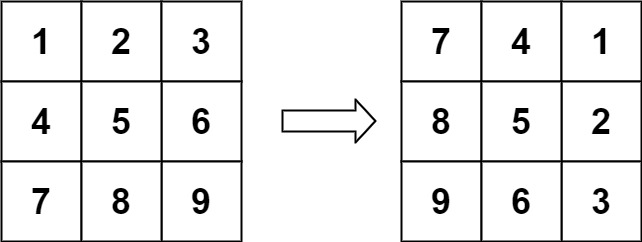
Input: matrix = [[1,2,3],[4,5,6],[7,8,9]]
Output: [[7,4,1],[8,5,2],[9,6,3]]
Example 2:
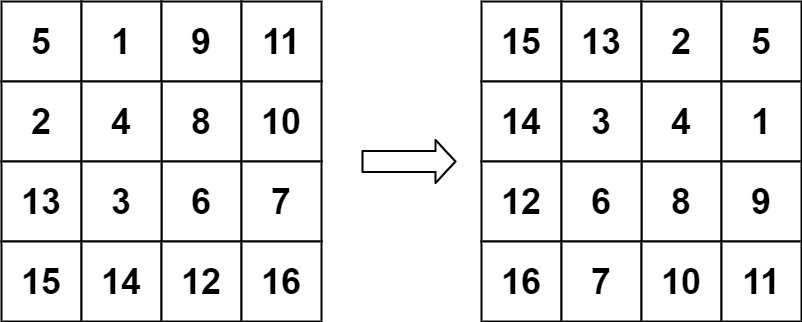
Input: matrix = [[5,1,9,11],[2,4,8,10],[13,3,6,7],[15,14,12,16]]
Output: [[15,13,2,5],[14,3,4,1],[12,6,8,9],[16,7,10,11]]
Constraints:
n == matrix.length == matrix[i].length1 <= n <= 20-1000 <= matrix[i][j] <= 1000
Solution
For a given pair, where is the row and is the column, we want to transform the value at that coordinate. Let's write down a
3x3case and see if we can't glean the general formula from old position to new position. -
Leetcode Lexicographically Smallest String After a Swap
2026-10-05 10:56
Given a string
scontaining only digits, return the lexicographically smallest string that can be obtained after swapping adjacent digits inswith the same parity at most once.Digits have the same parity if both are odd or both are even. For example, 5 and 9, as well as 2 and 4, have the same parity, while 6 and 9 do not.
Example 1:
Input: s = "45320"
Output: "43520"
Explanation:
`s[1] == '5'` and `s[2] == '3'` both have the same parity, and swapping them results in the lexicographically smallest string.
Example 2:
Input: s = "001"
Output: "001"
Explanation:
There is no need to perform a swap because `s` is already the lexicographically smallest.
Constraints:
2 <= s.length <= 100sconsists only of digits.
Solution
I first read the sentence
after swapping adjacent digits in
swith the same parity at most once.as allowing us to do multiple swaps in the string but each digit could only participate in 1 swap. For the first example, this would mean that we would swap the
5and3but then also swap the2and0. I'm pretty sure this is in fact what this sentence means grammatically and the "correct" version is a classic example of a misplaced modifier. A clearer definition would be something like -
Leetcode Time Needed to Inform All Employees
2026-09-28 15:20
A company has
nemployees with a unique ID for each employee from0ton - 1. The head of the company is the one withheadID.Each employee has one direct manager given in the
managerarray wheremanager[i]is the direct manager of thei-themployee,manager[headID] = -1. Also, it is guaranteed that the subordination relationships have a tree structure.The head of the company wants to inform all the company employees of an urgent piece of news. He will inform his direct subordinates, and they will inform their subordinates, and so on until all employees know about the urgent news.
The
i-themployee needsinformTime[i]minutes to inform all of his direct subordinates (i.e., After informTime[i] minutes, all his direct subordinates can start spreading the news).Return the number of minutes needed to inform all the employees about the urgent news.
Example 1:
Input: n = 1, headID = 0, manager = [-1], informTime = [0]
Output: 0
Explanation: The head of the company is the only employee in the company.
Example 2:
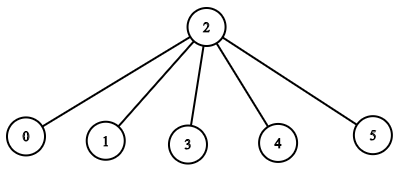
Input: n = 6, headID = 2, manager = [2,2,-1,2,2,2], informTime = [0,0,1,0,0,0] [Continue reading](/notes/202609281520) -
Leetcode Count Asterisks
2026-09-28 12:44
You are given a string
s, where every two consecutive vertical bars'|'are grouped into a pair. In other words, the 1st and 2nd'|'make a pair, the 3rd and 4th'|'make a pair, and so forth.Return the number of
'*'ins, excluding the*'*'between each pair of'|'.Note that each
'|'will belong to exactly one pair.Example 1:
Input: s = "l|*e*et|c**o|*de|"
Output: 2
Explanation: The considered characters are underlined: "l|*e*et|c**o|*de|".
The characters between the first and second '|' are excluded from the answer.
Also, the characters between the third and fourth '|' are excluded from the answer.
There are 2 asterisks considered. Therefore, we return 2.
Example 2:
Input: s = "iamprogrammer"
Output: 0
Explanation: In this example, there are no asterisks in s. Therefore, we return 0.
Example 3:
Input: s = "yo|uar|e**|b|e***au|tifu|l"
Output: 5
Explanation: All 5 asterisks are outside of pairs
Constraints:
1 <= s.length <= 1000sconsists of lowercase English letters, vertical bars'|', and asterisks'*'.scontains an even number of vertical bars'|'.
Solution
-
Leetcode Substring with Concatenation of All Words
2026-09-24 10:55
You are given a string
sand an array of stringswords. All the strings ofwordsare of the same length.A concatenated string is a string that exactly contains all the strings of any permutation of
wordsconcatenated.- For example, if
words = ["ab","cd","ef"], then"abcdef","abefcd","cdabef","cdefab","efabcd", and"efcdab"are all concatenated strings."acdbef"is not a concatenated string because it is not the concatenation of any permutation ofwords.
Return an array of the starting indices of all the concatenated substrings in
s. You can return the answer in any order.Example 1:
Input: s = "barfoothefoobarman", words = ["foo","bar"]
Output: [0,9]
Explanation:
- The substring starting at 0 is `"barfoo"`. It is the concatenation of `["bar","foo"]` which is a permutation of `words`.
- The substring starting at 9 is `"foobar"`. It is the concatenation of `["foo","bar"]` which is a permutation of `words`.
Example 2:
Input: s = "wordgoodgoodgoodbestword", words = ["word","good","best","word"]
Output: []
Explanation:
- There is no concatenated substring.
Example 3:
Input: s = "barfoofoobarthefoobarman", words = ["bar","foo","the"] [Continue reading](/notes/202609241055) - For example, if
-
Leetcode Minimum Energy to Maintain Brightness
2026-09-22 21:58
You are given an integer
n, representingnlight bulbs arranged in a line and indexed from 0 ton - 1.You are also given an integer
brightnessand a 2D integer arrayintervals, whereintervals[i] = [start_i, end_i]represents an inclusive time interval during which the lighting requirement must be satisfied.At each time unit, every bulb can independently be either on or off. A bulb that is on illuminates its own position and its adjacent positions, if they exist.
The total illumination at a time unit is the number of illuminated positions. Each position is counted at most once.
For every integer time unit covered by at least one interval in
intervals, the total illumination must be at leastbrightness. At time units not covered by any interval, all bulbs may remain off. Each bulb that is on consumes 1 unit of energy for that time unit.Return an integer denoting the minimum total energy required.
Example 1:
Input: n = 5, brightness = 5, intervals = [[6,12]] Output: 14 Explanation: - Turn on the light bulbs at positions 1 and 4. - Current state of line: `0 1 0 0 1`. - All 5 positions are illuminated, so the required brightness is reached. [Continue reading](/notes/202609222158) -
Leetcode Reverse Prefix of Word
2026-09-22 17:28
Given a 0-indexed string
wordand a characterch, reverse the segment ofwordthat starts at index0and ends at the index of the first occurrence ofch(inclusive). If the characterchdoes not exist inword, do nothing.- For example, if
word = "abcdefd"andch = "d", then you should reverse the segment that starts at0and ends at3(inclusive). The resulting string will be"dcbaefd".
Return the resulting string.
Example 1:
Input: word = "abcdefd", ch = "d"
Output: "dcbaefd"
Explanation: The first occurrence of "d" is at index 3.
Reverse the part of word from 0 to 3 (inclusive), the resulting string is "dcbaefd".
Example 2:
Input: word = "xyxzxe", ch = "z"
Output: "zxyxxe"
Explanation: The first and only occurrence of "z" is at index 3.
Reverse the part of word from 0 to 3 (inclusive), the resulting string is "zxyxxe".
Example 3:
Input: word = "abcd", ch = "z"
Output: "abcd"
Explanation: "z" does not exist in word.
You should not do any reverse operation, the resulting string is "abcd".
Constraints:
1 <= word.length <= 250wordconsists of lowercase English letters.
- For example, if
-
Leetcode Sum of Floored Pairs
2026-09-17 10:30
Given an integer array
nums, return the sum offloor(nums[i] / nums[j])for all pairs of indices0 <= i, j < nums.lengthin the array. Since the answer may be too large, return it modulo10^9 + 7.The
floor()function returns the integer part of the division.Example 1:
Input: nums = [2,5,9]
Output: 10
Explanation:
floor(2 / 5) = floor(2 / 9) = floor(5 / 9) = 0
floor(2 / 2) = floor(5 / 5) = floor(9 / 9) = 1
floor(5 / 2) = 2
floor(9 / 2) = 4
floor(9 / 5) = 1
We calculate the floor of the division for every pair of indices in the array then sum them up.
Example 2:
Input: nums = [7,7,7,7,7,7,7]
Output: 49
Constraints:
1 <= nums.length <= 10^51 <= nums[i] <= 10^5
Other solutions
Obviously this works but it's too slow.
const MODULO: i64 = 1_000_000_007;So what's the trick? When we look at one denominator
jwe know that thefloor-ed value will be constant for a range of numerators. For instance, withnums = [1, 2, 3, 10, 11, 12, 13, 20]andj = 10we have[1, 2, 3],[10, 11, 12, 13], and[20]as the buckets corresponding to0,1, and2. So the sum (for onlyj = 10) is0*3 + 1*4 + 2*1. This also shows us that we can sort and ignore all numbersi < j. -
Leetcode Perfect Number
2026-09-15 12:27
A perfect number is a positive integer that is equal to the sum of its positive divisors, excluding the number itself. A divisor of an integer
xis an integer that can dividexevenly.Given an integer
n, returntrueifnis a perfect number, otherwise returnfalse.Example 1:
Input: num = 28
Output: true
Explanation: 28 = 1 + 2 + 4 + 7 + 14
1, 2, 4, 7, and 14 are all divisors of 28.
Example 2:
Input: num = 7
Output: false
Constraints:
1 <= num <= 10^8
Solution
The key insight to this one is that we only need to check up to the square root of a number since we can just add its pair when we find one. For instance, to get all the clean divisors of
28we can check1through6since when we check4we also get7from the division check.Other than that, there's some bookkeeping for adding
1and also not adding the numbernitself (though we could instead check against2nfor a match). This definition also excludes1from being a perfect number so in the second version below we short circuit that. -
Leetcode Number of Perfect Pairs
2026-09-14 17:42
You are given an integer array
nums.A pair of indices
(i, j)is called perfect if the following conditions are satisfied:i < j- Let
a = nums[i],b = nums[j]. Then:min(|a - b|, |a + b|) <= min(|a|, |b|)max(|a - b|, |a + b|) >= max(|a|, |b|)
Return the number of distinct perfect pairs.
Note: The absolute value
|x|refers to the non-negative value ofx.Example 1:
Input: nums = [0,1,2,3]
Output: 2
Explanation:
There are 2 perfect pairs
(i, j)(a, b)min(abs(a − b), abs(a + b))min(abs(a), abs(b))max(abs(a − b), abs(a + b))max(abs(a), abs(b))(1, 2) (1, 2) min(abs(1 − 2), abs(1 + 2)) = 11 max(abs(1 − 2), abs(1 + 2)) = 32 (2, 3) (2, 3) min(abs(2 − 3), abs(2 + 3)) = 12 max(abs(2 − 3), abs(2 + 3)) = 53 Example 2:
Input: nums = [-3,2,-1,4]
Output: 4
Explanation:
There are 4 perfect pairs
|
(i, j)|(a, b)|min(abs(a − b), abs(a + b))|min(abs(a), abs(b))|max(abs(a − b), abs(a + b))|max(abs(a), abs(b))| -
Leetcode Find Indices of Stable Mountains
2026-09-14 11:14
There are
nmountains in a row, and each mountain has a height. You are given an integer arrayheightwhereheight[i]represents the height of mountaini, and an integerthreshold.A mountain is called stable if the mountain just before it (if it exists) has a height strictly greater than
threshold. Note that mountain 0 is not stable.Return an array containing the indices of all stable mountains in any order.
Example 1:
Input: height = [1,2,3,4,5], threshold = 2
Output: [3,4]
Explanation:
- Mountain 3 is stable because height[2] == 3 is greater than threshold == 2.
- Mountain 4 is stable because height[3] == 4 is greater than threshold == 2.
Example 2:
Input: height = [10,1,10,1,10], threshold = 3
Output: [1,3]
Example 3:
Input: height = [10,1,10,1,10], threshold = 10
Output: []
Constraints:
2 <= n == height.length <= 1001 <= height[i] <= 1001 <= threshold <= 100
Solution
This is as simple as it seems. Just figure out if the entry satisfies the predicate and add it to the list if it does.
First pass, relatively naïve and non-"rusty"
-
Leetcode Maximum Number of Words You Can Type
2026-09-12 16:50
There is a malfunctioning keyboard where some letter keys do not work. All other keys on the keyboard work properly.
Given a string
textof words separated by a single space (no leading or trailing spaces) and a stringbrokenLettersof all distinct letter keys that are broken, return the number of words intextyou can fully type using this keyboard.Example 1:
Input: text = "hello world", brokenLetters = "ad"
Output: 1
Explanation: We cannot type "world" because the 'd' key is broken.
Example 2:
Input: text = "leet code", brokenLetters = "lt"
Output: 1
Explanation: We cannot type "leet" because the 'l' and 't' keys are broken.
Example 3:
Input: text = "leet code", brokenLetters = "e"
Output: 0
Explanation: We cannot type either word because the 'e' key is broken.
Constraints:
1 <= text.length <= 1040 <= brokenLetters.length <= 26textconsists of words separated by a single space without any leading or trailing spaces.- Each word only consists of lowercase English letters.
brokenLettersconsists of distinct lowercase English letters.
Solution
For this problem we just need to look at every word and check if any of our broken letters are in them.
-
Leetcode Find Closest Number to Zero
2026-09-10 12:33
Given an integer array
numsof sizen, return the number with the value closest to0innums. If there are multiple answers, return the number with the largest value.Example 1:
Input: nums = [-4,-2,1,4,8]
Output: 1
Explanation:
The distance from -4 to 0 is |-4| = 4.
The distance from -2 to 0 is |-2| = 2.
The distance from 1 to 0 is |1| = 1.
The distance from 4 to 0 is |4| = 4.
The distance from 8 to 0 is |8| = 8.
Thus, the closest number to 0 in the array is 1.
Example 2:
Input: nums = [2,-1,1]
Output: 1
Explanation: 1 and -1 are both the closest numbers to 0, so 1 being larger is returned.
Constraints:
1 <= n <= 1000-105 <= nums[i] <= 105
Solution
This one is straightforward as a problem, but the simplicity of the solution relies on some cool Rust features to be so concise.
First, we have a
max_by_keyfunction (there are similar functions likesort_by_key,min_by_key, and more) that will allow us to iterate through an iterator, provide somekeyfor each element, and then only retain themax. -
Leetcode Split Strings by Separator
2026-09-09 14:41
Given an array of strings
wordsand a characterseparator, split each string inwordsbyseparator.Return an array of strings containing the new strings formed after the splits, excluding empty strings.
separatoris used to determine where the split should occur, but it is not included as part of the resulting strings.- A split may result in more than two strings.
- The resulting strings must maintain the same order as they were initially given.
Example 1:
Input: words = ["one.two.three","four.five","six"], separator = "."
Output: ["one","two","three","four","five","six"]
Explanation: In this example we split as follows:

"one.two.three" splits into "one", "two", "three"
"four.five" splits into "four", "five"
"six" splits into "six"

Hence, the resulting array is ["one","two","three","four","five","six"].
Example 2:
Input: words = ["$easy$","$problem$"], separator = "$"
Output: ["easy","problem"]
Explanation: In this example we split as follows:

"$easy$" splits into "easy" (excluding empty strings)
"$problem$" splits into "problem" (excluding empty strings)

Hence, the resulting array is ["easy","problem"].
Example 3:
-
Leetcode Split Array Into Maximum Number of Subarrays
2026-08-31 15:01
You are given an array
numsconsisting of non-negative integers.We define the score of subarray
nums[l..r]such thatl <= rasnums[l] AND nums[l + 1] AND ... AND nums[r]where AND is the bitwiseANDoperation.Consider splitting the array into one or more subarrays such that the following conditions are satisfied:
- Each element of the array belongs to exactly one subarray.
- The sum of scores of the subarrays is the minimum possible.
Return the maximum number of subarrays in a split that satisfies the conditions above.
A subarray is a contiguous part of an array.
Example 1:
Input: nums = [1,0,2,0,1,2]
Output: 3
Explanation: We can split the array into the following subarrays:
- [1,0]. The score of this subarray is 1 AND 0 = 0.
- [2,0]. The score of this subarray is 2 AND 0 = 0.
- [1,2]. The score of this subarray is 1 AND 2 = 0.
The sum of scores is 0 + 0 + 0 = 0, which is the minimum possible score that we can obtain.
It can be shown that we cannot split the array into more than 3 subarrays with a total score of 0. So we return 3.
Example 2:
Input: nums = [5,7,1,3] Output: 1 Explanation: We can split the array into one subarray: [5,7,1,3] with a score of 1, which is the minimum possible score that we can obtain. [Continue reading](/notes/202608311501) -
Leetcode Top Travelers
2026-08-31 11:09
Table:
Users+---------------+---------+ | Column Name | Type | +---------------+---------+ | id | int | | name | varchar | +---------------+---------+ id is the column with unique values for this table. name is the name of the user.Table:
Rides+---------------+---------+ | Column Name | Type | +---------------+---------+ | id | int | | user_id | int | | distance | int | +---------------+---------+ id is the column with unique values for this table. user_id is the id of the user who traveled the distance "distance".Write a solution to report the distance traveled by each user.
Return the result table ordered by
travelled_distancein descending order, if two or more users traveled the same distance, order them by theirnamein ascending order.The result format is in the following example.
Example 1:
Input: Users table: +------+-----------+ | id | name | +------+-----------+ | 1 | Alice | | 2 | Bob | | 3 | Alex | | 4 | Donald | | 7 | Lee | | 13 | Jonathan | | 19 | Elvis | +------+-----------+ Rides table: [Continue reading](/notes/202608311109) -
Leetcode Find the Difference
2026-08-24 13:38
You are given two strings
sandt.String
tis generated by random shuffling stringsand then add one more letter at a random position.Return the letter that was added to
t.Example 1:
Input: s = "abcd", t = "abcde"
Output: "e"
Explanation: 'e' is the letter that was added.
Example 2:
Input: s = "", t = "y"
Output: "y"
Constraints:
0 <= s.length <= 1000t.length == s.length + 1sandtconsist of lowercase English letters.
Solution
This one is really straightforward. We just create a frequency count of the characters in the string, then decrement them until we find the one that has an extra count.
There is however a cool, different solution that uses
xoron the character bytes. -
Leetcode Two Sum
2026-08-21 13:29
You are given an array of integers
numsand an integertarget, return indices of the two numbers such that they add up totarget.You may assume that each input would have exactly one solution, and you may not use the same element twice.
You can return the answer in any order.
Example 1:
Input: nums = [2,7,11,15], target = 9
Output: [0,1]
Explanation: Because nums[0] + nums[1] == 9, we return [0, 1].
Example 2:
Input: nums = [3,2,4], target = 6
Output: [1,2]
Example 3:
Input: nums = [3,3], target = 6
Output: [0,1]
Constraints:
2 <= nums.length <= 10^4-10^9 <= nums[i] <= 10^9-10^9 <= target <= 10^9- Only one valid answer exists.
Follow-up: Can you come up with an algorithm that is less than
O(n^2)time complexity?Solution
The trick to get a better than complexity is to understand that as we go through the list of integers, we can keep track of the numbers we see. Then in the future, we check if that number was in the list.
For instance, if we have the array
[1, 7, 8, 4, 9]and the target is5. When we read the first number1, we store that we've seen it. Then when we see4we check if5 - 4 = 1is in the list of seen numbers, find it, and get our match. -
Leetcode
Programming puzzles
2026-08-21 13:28
A centralized list of some Leetcode problems I've solved with write-up explanations and interesting learning deep dives.
-
Advent of Code 2024 Day 11
Plutonian Pebbles
2024-12-11 00:00
Today we're visiting the ancient civilization on Pluto from 2019 day 20 and find some interesting physics-defying stones.
-
Advent of Code 2024 Day 10
Hoof It
2024-12-10 00:00
Today we're back at the Lava Production Facility from 2023 day 15 helping reindeer find the best hiking routes around their floating island.
-
Advent of Code 2024 Day 09
Disk Fragmenter
2024-12-09 00:00
Today we're back under the sea with our amphipod friends from 2021 day 23 and need to help one of them defragment their hard drive.
-
Advent of Code 2024 Day 08
Resonant Collinearity
2024-12-08 00:00
Today we're visiting the roof of a top-secret Easter Bunny installation and need to put a stop to their plot to get people to buy Easter Bunny brand Imitation Mediocre Chocolate as a Christmas gift.
-
Advent of Code 2024 Day 07
Bridge Repair
2024-12-07 00:00
Today we're visiting the rope bridge from 2022 day 9 and need to help the elves repair it by sorting out there test calculations.
-
Advent of Code 2024 Day 06
Guard Gallivant
2024-12-06 00:00
Today we visit the suit manufacturing plant from 2018 day 5 and need to avoid creating time paradoxes by hiding from the guard.
-
Advent of Code 2024 Day 05
Print Queue
2024-12-05 00:00
Today we found the printer from 2017 day 1 and need to help sort it out.
-
Advent of Code 2024 Day 04
Ceres Search
2024-12-04 00:00
Today were visiting the Ceres monitoring station from 2019 day 10 and helping the station chief solve her word searches.
-
Advent of Code 2024 Day 03
Mull It Over
2024-12-03 00:00
Today we're visiting the toboggan rental shop from 2020 day 2 and need to help the elves with corrupted data in their computers.
-
Advent of Code 2024 Day 02
Red-Nosed Report
2024-12-02 00:00
We've made it to our first location in our search for the chief elf historian, the reindeer reactor from 2015 day 19. The reindeer need some help finding out which series of readings from their reactor are safe.
-
Advent of Code 2024 Day 01
Historian Hysteria
2024-12-01 00:00
This year finds us helping elf historians track down their chief historian who has gone missing and needs to be back for the sleigh launch on Christmas. Today we're comparing lists of numbers for historians.
-
Advent of Code 2024
A season of code
2024-11-30 23:59
#structure #blog #project #tech
We're back for another year or saving Christmas through the power of programming.